
Urban Digital Canvas Shanghai
The Urban Digital Canvas Exhibition took place as part of the 3rd Shanghai International Light Festival in the Changning District of Shanghai and ran 24 September 2026 until 8 October 2026. This project, a collaboration between the ACM SIGGRAPH Digital Arts Community, the Chewing Theory Art Collective, and the City of Shanghai showcased an international set of images and videos designed for site-specific display in the city.
Many cities around the world feature advanced digital screens in public areas, yet these often lack culturally meaningful content beyond advertisements. Our project transforms these screens for high-quality digital art, enhancing their cultural and educational value. This project aims to foster international cultural exchange by introducing outstanding global digital art works to Chinese audiences, and by bringing these site-specific urban digital installations to the attention of the ACM SIGGRAPH Digital Arts Community. We welcome submissions that take advantage of the site specific qualities of each display site. Projects will be shown in a loop, and in relation to other artworks around the city. Visitors will be encouraged to discover all the works as they travel through the city.
The jury considered a wide range of submissions, and were especially interested in work engaging with two key themes:
- AI, Media & Urban Life
This theme offers an exploration of the connection between technology, urban life, and nature through the lens of AI. Generative AI affords new opportunities for both media creation and critical reflection on its impact. How can we reflect on those questions on site in the city itself?
- Reimagining Cultural Legacies
Digital interpretations of traditional culture, including intangible cultural heritage and local folklore, have been an import part of the work of digital humanities, museology, and cultural organizations. How can we bring the that richness into our lived experience in contemporary urban environments?
On Site and Online
The exhibition opportunity was presented at the ACM SIGGRAPH 2026 Conference as part of the Digital Arts Community programming. Now that the on-site exhibition in Shanghai is concluded, this website serves to provide online documentation of the exhibition. Project documentation will be showcased at future SIGGRAPH conferences, and hopefully inspire new Urban Digital Canvas interventions.
Venues
Click on venue images below to enlarge them. See also the PDF of exhibition sites.
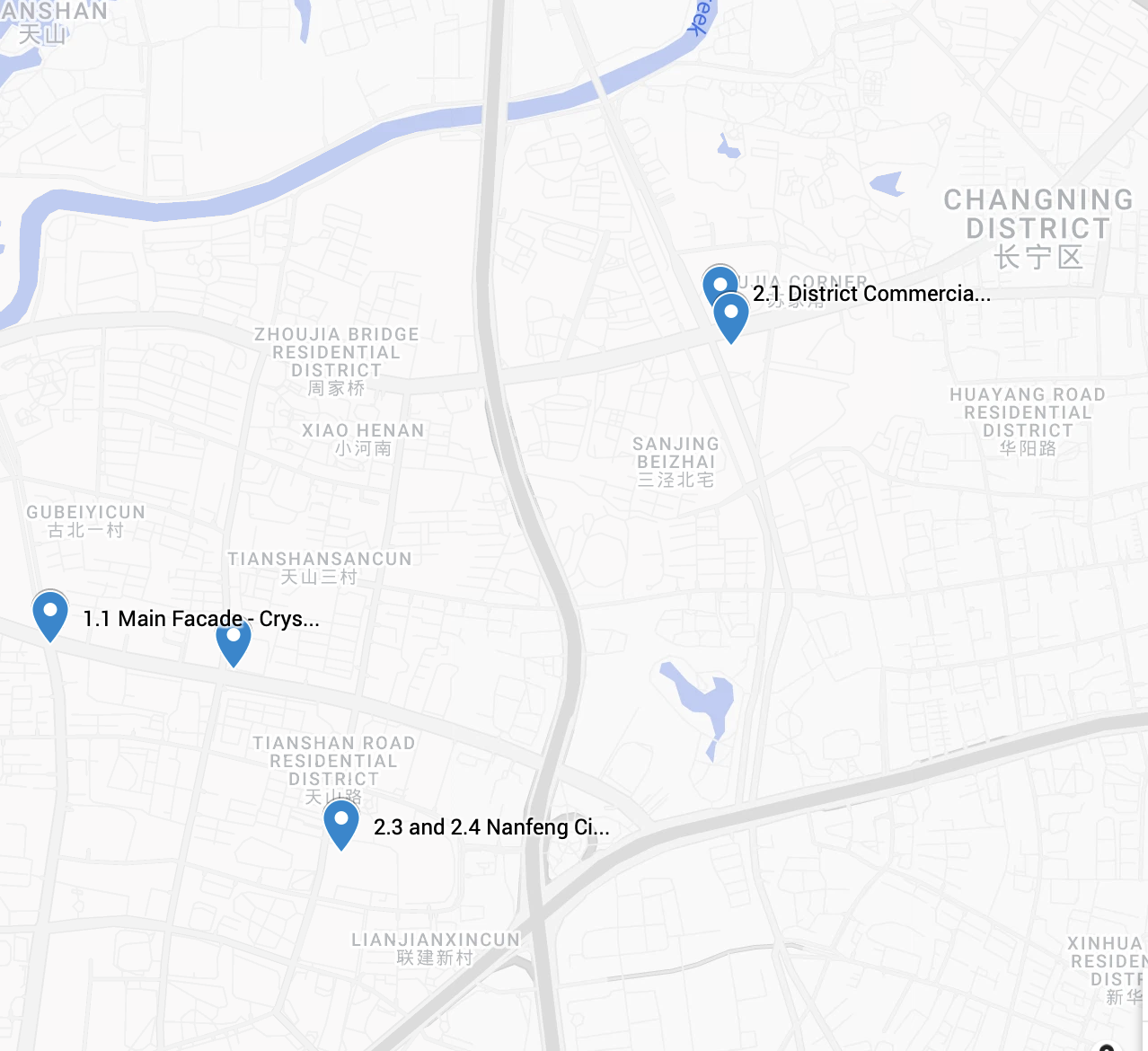
1.1 Main Facade – Crystal Bridge
Tianshan Rd × Gubei Rd, This site is a LED facade system activated at night.
Pixel: W430*H730, Format: MP4, AVI, Codec: H.264, Audio: not supported (silent video)
1.2 Sunken Square Projection Zone – Jingyao Hongqiao
Tianshan Rd × Gubei Rd
This is the back of the 1.1 Main Facade LED projection zone at Crystal Bridge. It is a !90m glass curtain wall facing inwards towards a central square. There is a central area of 36.4 meters with wings of 26.8 meters, with a panel height of 8.76 meters. This is the only venue that may include sound. The DAC showcase will follow a mapping show by the Changning District each night.
single submission file of 9000x900px (or 12000x1200px – 10:1 aspect ratio) – note cutout for central screen area when selecting your proposed video
Sound Supported
MP4 H.264/5
30 seconds-2 minutes preferred (video will loop)
1.3 Crystal Bridge Indoor Lobby
Tianshan Rd × Gubei Rd
Indoor space
2×2 LED walls at 1920x1152px in two L-shaped corner pairs
Each pair is suitable for a single naked-eye 3d canvas
Sound is supported here
This indoor site is ground-floor lobby of the same tower that carries the Crystal Bridge main façade (venue 1.1). The lobby has four LED walls, 5 m × 3 m each (1,920 × 1,152 px), arranged as two L-shaped corner pairs. Each pair wraps a corner and can be used as a single “naked-eye 3D” canvas; the screens can play in sync as one image or run independently. Sound is supported in this space.
2.1 District Commercial Screens – Longemont
1018 Changning Rd
The District Commercial Screens are located at different points of the Changning District as noted below.
The Longemont site includes two screen faces, so would be ideal for anamorphic illusion/3D billboard effects. The other screens are of varying aspect ratios as noted below. Proposals for screens 2.2-6 will be considered together, with the understanding that contributors may be asked to adjust their videos to fit specific spaces.
Left 2496×1984px
Right 1024×1984px
MP4/H.264
2.2 – 2.6 District Commercial Screens – Shanghai Book City, Nanfeng City 1 and 2, Huijin Department Store, Xinda Plaza
MP4 Video (see resolutions below)
Codec: H.264
Audio: not supported (silent video)
2.2 Shanghai Book City, 1057 Changning Road, 2048x1664px
2.3 Nanfeng City 1, 100 Zunyi Road, 2000x1040px
2.4 Nanfeng City 2, 100 Zunyi Road, 3100x1000px
2.5 Huijin Department Store, 900 Tianshan Rd, 1216x496px
2.6 Xinda Plaza, 1158 Xiehe Road, 9472×800px
These screens scattered throughout the Changning District will show artwork intermixed with other images and videos, including commercial images, throughout the day for the duration of the festival.
The proposals for these sites will be considered together. Submit one standard format video for your proposal, and include any additional information about preferences or suitability for a specific sites in the Additional Notes section of the submission form. The curators will work with selected contributors to ensure file formats and aspect ratios are suitable to the venues selected.
MP4
HD 16:9 aspect ratio for submissions (to be adjusted/downsampled based on final exhibition site)
 |

Victoria Szabo is a Research Professor of Visual and Media Studies and Gender, Sexuality, and Feminist Studies at Duke University. She also directs the Information Science + Studies Program and the PhD in Computational Media, Arts & Cultures. She has a PhD in Victorian Literature and Culture and works in digital humanities and media art, with an emphasis on location-based urban histories, multimodal cultural heritage, and digital storytelling. Before moving to Duke, she worked in Academic Technology at Stanford University. She is also part of the Psychasthenia Studio Art collaborative and the international Visualizing Cities consortium. She has been involved in a variety of SIGGRAPH Art-related roles, including SIGGRAPH Art Gallery Chair, Art Papers Chair, Art Papers Chair for SIGGRAPH Asia, Chair of the Year-Round Digital Arts Community for the Org, and is the current Chair of the Arts Advisory Group. She is also part of the SIGGRAPH Governance Committee. Victoria is the Art Papers Chair for SIGGRAPH 2025.

HE Wei is a curator, digital-media artist, and designer based in Beijing and New York, and the founder of the creative cultural studio Chewing Theory. His interdisciplinary practice spans installation, AI-generated imagery, VR/MR, and theatrical performance, focused on reconstructing traditional culture and intangible cultural heritage within contemporary digital contexts. He was a contributor and presenter at SIGGRAPH 2025 Real-Time Live! He was a member of NEW INC, the New Museum of Contemporary Art’s art, design, and technology incubator in New York City. He serves on the graduate mentor faculty in Stage Design at the Central Academy of Drama in Beijing, and is an Executive Committee Member of the China Computer Federation (CCF) Computer Applications Technical Committee and a member of Tsinghua University’s x-lab. His installations and immersive works have been exhibited at venues including the Milan Expo, Grand Central Terminal, the New Museum of Contemporary Art, the Ullens Center for Contemporary Art (UCCA), 798CUBE, and the Chinese Traditional Culture Museum, etc.